The Sound of Silence: How a Deaf Composer Rewrote the Rules of American Music
The Girl Who Felt Music in Her Bones
Evelyn Glennie was eight years old when the music stopped. Not all at once — hearing loss rarely works that way. Instead, it faded gradually, like someone slowly turning down the volume on the world. By twelve, she was profoundly deaf. By thirteen, she'd decided that didn't matter.
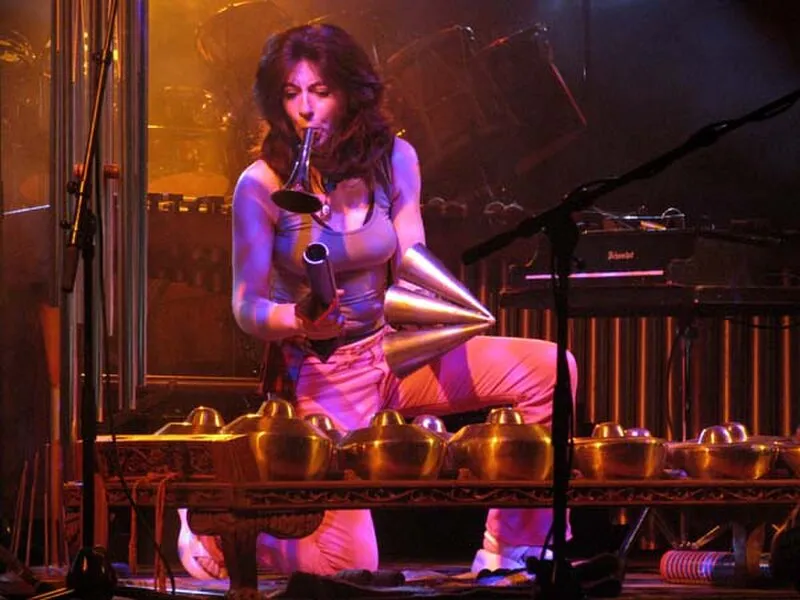 Photo of Evelyn Glennie, via Wikidata/Wikimedia Commons
The decision came during a school music class in rural Scotland. Her teacher, assuming Glennie's deafness meant the end of her musical education, suggested she focus on academics instead. Glennie's response was to walk to the front of the classroom, remove her shoes, and place her hands on the piano while a classmate played.
She could feel every note.
"Sound isn't just what you hear," she would later explain. "It's what you feel, what you see, what you experience with your entire body." That day in the classroom, feeling vibrations travel through the piano into her hands and feet, Glennie discovered something that hearing musicians often miss: music is physical before it's auditory.
The Conservatory That Almost Wasn't
When Glennie applied to the Royal Academy of Music in London, the response was polite but firm: deaf students weren't admitted to the percussion program. The reasoning seemed logical — how could someone who couldn't hear become a percussionist?
 Photo: Royal Academy of Music, via lehners-beeren.at
Glennie's audition changed that policy forever.
She arrived barefoot, as she always performed, explaining that she felt rhythm and pitch through her feet and hands. She demonstrated how different parts of her body picked up different frequencies — low tones through her feet and legs, higher pitches through her hands and chest. What the faculty witnessed wasn't just a deaf person playing music; it was someone who understood sound in ways they'd never considered.
The Academy didn't just admit her — they redesigned their entire approach to teaching percussion. Glennie's methods, born from necessity, revealed that even hearing musicians were missing crucial elements of their craft by relying too heavily on their ears alone.
The Science of Feeling Sound
Glennie's breakthrough wasn't just personal — it was scientific. Her approach to "hearing" through touch led to groundbreaking research into how humans actually perceive sound. Scientists discovered that what we call "hearing" involves far more than just our ears.
Sound waves create vibrations that travel through solid objects and air. These vibrations can be felt through skin, bones, and organs throughout the body. Glennie had simply learned to pay attention to information that hearing people typically ignore.
She developed techniques that seemed impossible to traditional musicians. She could distinguish between different pitches by feeling where vibrations resonated in her body. She learned to "tune" timpani by touching the drumheads and feeling the tension. She could identify the acoustic properties of different concert halls by walking across the stage barefoot.
What started as adaptation became innovation. Glennie wasn't just compensating for hearing loss — she was accessing aspects of music that most musicians never experience.
Redefining What It Means to Listen
By the 1990s, Glennie had become the world's first full-time solo percussionist, performing with major orchestras worldwide. But her influence extended far beyond performance. She was revolutionizing how musicians, scientists, and audiences understood the relationship between sound and sensation.
Her concerts became demonstrations of expanded musical perception. Audiences watched her perform complex pieces while maintaining perfect timing and pitch, despite being unable to hear in the traditional sense. Many reported that watching Glennie perform made them more aware of music's physical properties — the way bass notes seemed to vibrate in their chests, how different instruments created distinct tactile sensations.
Glennie's approach influenced hearing musicians to incorporate more physical awareness into their playing. Percussion students began training barefoot, learning to feel rhythms through their feet. Conductors started paying attention to the vibrations they felt through the podium.
The Ripple Effect of Radical Adaptation
Glennie's success opened doors for other musicians with hearing differences, but her impact reached beyond the music world. Her methods influenced research into sensory substitution — how people can use one sense to gather information typically processed by another.
Her techniques found applications in fields ranging from architecture to medicine. Concert hall designers began considering how spaces feel as well as how they sound. Doctors studying balance disorders learned from her methods of using vibration to maintain spatial awareness.
Most importantly, Glennie challenged fundamental assumptions about disability and limitation. She didn't overcome her deafness — she transformed it into a different kind of musical superpower.
The Lesson That Resonates
Evelyn Glennie's story isn't about triumph over disability. It's about the discovery that what we consider limitations often reveal unexplored possibilities. Her deafness didn't make her a worse musician — it made her a different kind of musician, one who accessed aspects of sound that traditional training overlooks.
Today, Glennie continues to perform, compose, and teach worldwide. She's created over 200 commissioned works and collaborated with artists ranging from classical orchestras to electronic music pioneers. Her approach to sound continues to influence musicians, scientists, and anyone interested in expanding human perception.
The girl who was told deaf people couldn't make music didn't just prove that assumption wrong — she revealed that the assumption itself was based on too narrow a definition of what music actually is. In a world that often sees hearing as essential to musical experience, Glennie discovered that the most profound music might be felt as much as heard.
Her legacy lives in every musician who now pays attention to the physical sensation of their instrument, every concert hall designed with vibration in mind, and every person who's learned that there's always another way to experience what seems impossible.