Nobody Knows His Name. Everybody Lives Inside His Idea.
The Kid Who Wasn't Supposed to Be There
Paul Baran's father sold nails and pipe fittings out of a small hardware store in South Philadelphia. It wasn't a glamorous beginning, and nobody in the neighborhood was placing bets on the quiet kid with the thick accent and the habit of asking too many questions about how things worked.
 Photo: South Philadelphia, via c8.alamy.com
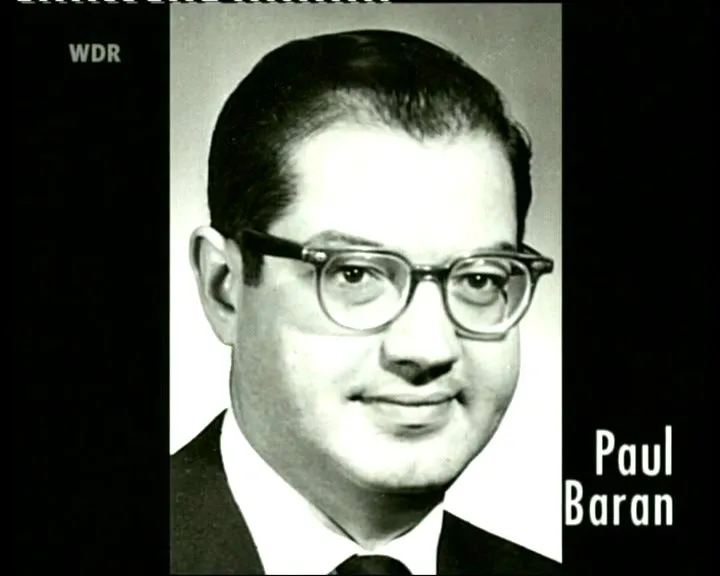 Photo: Paul Baran, via www.rostfrank.de
Baran was born in Grodno, Poland in 1926, and the family came to America when he was two. He grew up watching his father figure out problems with whatever was on hand. That kind of practical problem-solving — not the textbook kind, but the what do we actually have to work with kind — would define everything Paul Baran ever built.
He applied to engineering programs after high school. Got turned away. Ended up studying electrical engineering at Drexel University instead of the more prestigious schools he'd aimed for. He graduated in 1949 and bounced through a few unremarkable jobs before landing at the RAND Corporation in 1959 — a Cold War think tank where brilliant people were paid to imagine the unimaginable.
That's where everything changed. Not because someone handed him an opportunity. Because he started asking a question nobody else thought was worth asking.
The Problem Nobody Else Was Solving
It was the height of the Cold War. The United States military was deeply worried about one specific scenario: a Soviet nuclear strike that would knock out the country's communications infrastructure in the opening minutes of an attack. If the phone lines went down — if the centralized switching stations that routed military communications were destroyed — the U.S. would lose the ability to coordinate a response. The whole system depended on central hubs. Destroy the hubs, destroy the network.
Baran looked at that problem and saw something nobody else had articulated clearly: the architecture itself was the vulnerability. It wasn't a matter of hardening the existing system. The existing system was, by design, fragile.
He proposed something radical. Instead of routing communications through central hubs, you distribute the whole thing. Break every message into small chunks — he called them "message blocks" — and send each chunk independently across a web of interconnected nodes. Every node would be equal. Every path would be redundant. If one node was destroyed, the chunks would find another route. The network would heal itself.
He called it "distributed communications." We now call it packet switching. And it is the literal foundation of the internet you are reading this on.
The Part Where Everyone Said No
Baran published his findings in a series of RAND reports between 1960 and 1962. He presented the idea to the Air Force, which was funding the research. The response was something between skepticism and open hostility.
The engineers at AT&T — who controlled the country's telecommunications infrastructure and had enormous institutional prestige — told him his idea was not only impractical but technically impossible. These were not small voices. AT&T had built the modern phone system. They had rooms full of people who understood communications networks better than almost anyone alive.
They were also completely wrong.
Baran wasn't deterred exactly, but he was realistic. He knew that even if he was right, getting a massive bureaucracy to implement a genuinely new idea was a different kind of problem from solving the idea itself. He later said that he shelved the project partly because he didn't think the military had the technical personnel to build it correctly. He worried that a badly implemented version would discredit the concept entirely.
So he walked away from it. Filed the papers. Moved on to other projects.
Someone Else Got the Credit — And Baran Was Fine With It
In the mid-1960s, a British scientist named Donald Davies independently arrived at almost exactly the same concept and gave it the name that stuck: packet switching. Around the same time, the U.S. Defense Department's ARPA was developing what would become ARPANET — the direct ancestor of the internet — and Baran's RAND reports were sitting in a filing cabinet, waiting to be rediscovered.
When ARPANET's architects found his work, they realized he'd already mapped the territory. His reports became foundational documents. The architecture they built looked a lot like what Baran had drawn on paper a decade earlier.
Here's the remarkable thing about Paul Baran: he didn't spend the rest of his life bitter about it. He went on to co-found a string of technology companies, helped develop early cable modem technology, and kept inventing until his death in 2011. He received honors late in life — the Harold Pender Award, induction into the National Inventors Hall of Fame — but he remained largely unknown to the general public.
He once said, in a characteristically understated way, that the internet was "not any one person's invention." He meant it genuinely. He understood that big ideas move through history in complicated ways, that credit is often a matter of timing and visibility rather than contribution.
What an Outsider Actually Sees
There's a reason Paul Baran saw what the AT&T engineers missed. He wasn't protecting anything. He had no institutional stake in the existing system, no career built on the assumption that centralized networks were the only way. He was a hardware store kid from South Philly who'd been told more than once that he wasn't quite the right fit for the rooms where important decisions got made.
That distance — from prestige, from consensus, from the comfortable certainty of expertise — is exactly what let him see the problem clearly. The experts knew too much about how things worked to imagine how differently they could work.
Every time you send a text message, stream a video, or load a webpage, you are living inside an idea that the establishment once called impossible. The man who had that idea first never became a household name. His father sold nails. His early applications got rejected. His most important work sat in a filing cabinet for years.
And yet the entire connected world runs on his logic.
That's not a footnote. That's the story.