What She Heard in the Silence: The Visually Impaired Reporter Who Brought Down a City Hall
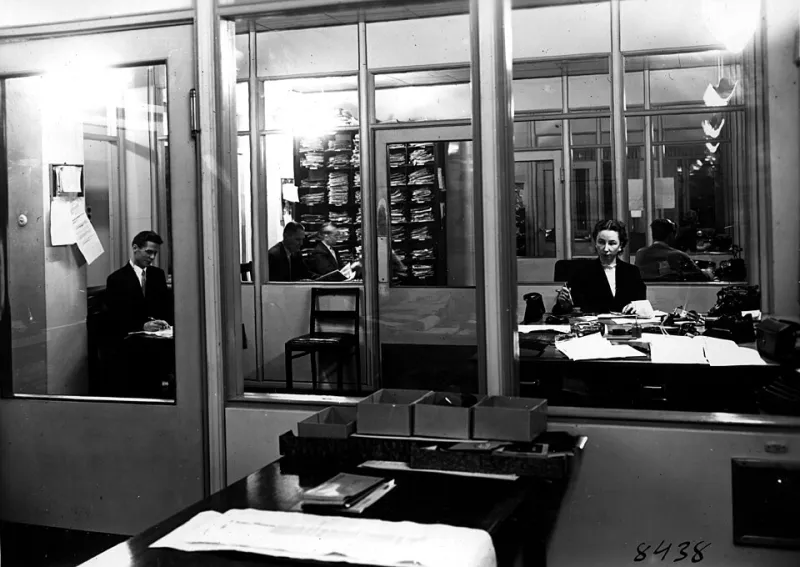
Photo: Unknown, CC BY 4.0, via Wikimedia Commons
The Hiring Room
The conversation always ended the same way.
She would come in prepared — clippings from her college paper, a portfolio of freelance work, references from professors who used words like tenacious and unusually perceptive. She would sit across from an editor who had already made up his mind before she sat down. And then, after a few polite minutes, she would hear the version of no that that particular editor had decided on.
Too difficult to accommodate in a fast-moving newsroom. Liability concerns. Assignments that required visual observation. The job, they said, was fundamentally about seeing things.
What none of those editors understood — what she would spend the next decade proving — was that the most important things a reporter ever observes are invisible.
Mid-Century, Mid-America
This was the 1950s, in a mid-sized American city that had the particular self-satisfaction of places that have been prosperous long enough to stop questioning themselves. The city government was old-money confident. The local paper covered it with the gentle touch of an institution reporting on another institution it fundamentally trusted.
Corruption, when it exists in that kind of environment, doesn't look like corruption. It looks like business as usual. It looks like the same names on the same committees year after year. It looks like contract awards that nobody scrutinizes because scrutiny would be rude.
The reporters who covered city hall every day had been looking at it so long they'd stopped seeing it. They'd been told the same reassuring story so many times that the story had become furniture.
She didn't have that problem. She had never been allowed into the room long enough to get comfortable.
Finding the Door
The job she finally got wasn't at a daily paper. It was at a small weekly — the kind of publication that ran church announcements and high school sports results and the occasional feature that the dailies hadn't bothered with. The editor who hired her, a former wire service reporter named Gerald who had come back to his hometown after a long career and didn't have much patience left for conventional thinking, looked at her portfolio and said something she had never heard before.
 Photo: Gerald, via resources.tidal.com
"I don't care what you can't see. Tell me what you can hear."
It was a practical question, not a philosophical one. He needed content. She needed a byline. They worked out an arrangement that gave her access to public meetings, press conferences, and the kind of community events that generated soft copy.
What Gerald got was more than he bargained for.
The Language of Evasion
Her visual impairment had, over the course of her life, done something to her other senses that she had long since stopped thinking of as compensation and started thinking of as simply how she experienced the world. Sound carried information that most people filtered out. The rhythm of someone's speech — the micro-pauses, the subtle shifts in register, the particular quality of a voice under pressure — was as readable to her as a facial expression is to a sighted person.
She could hear a lie. Not metaphorically. She could detect the specific vocal markers — the slight tightening, the overemphatic confidence, the fractional hesitation before a name — that indicated someone was managing information rather than sharing it.
At a city council budget meeting she attended in her third month at the weekly, she heard something in the public works director's voice during a routine question about contract renewals. Nothing dramatic. A half-second's worth of careful phrasing where loose phrasing would have been more natural.
She wrote it down. She went back through the public records she had learned to navigate through a combination of assistance and her own meticulous system of tactile organization. She started pulling threads.
The Investigation
What she found, over the course of eighteen months, was a contracting network that had been quietly redirecting public works funds through a series of shell vendors connected to three members of the city council. The mechanism wasn't sophisticated — it didn't need to be, because nobody had been looking for it. The amounts were large enough to matter and small enough, per transaction, to avoid triggering any formal review thresholds.
Building the case required the kind of source cultivation that most reporters do visually — reading body language, watching for tells, using physical presence as a persuasion tool. She did it entirely through voice.
She developed a technique she described to Gerald, years later, as listening for the door. Every source, she explained, has a version of the story they're willing to tell and a version they're holding back. Most reporters try to push through the door directly. She learned to wait near it — to ask questions that weren't quite the question she needed answered, to let silence accumulate in a conversation until the source filled it with something they hadn't planned to say.
One city employee, a mid-level procurement officer who had been bothered by what he'd seen for years but hadn't known who to tell, talked to her for three hours in a diner booth. He later told a colleague that he'd felt, for reasons he couldn't fully explain, that she already knew everything he was about to say. That it was safe to confirm it.
She had created that impression deliberately.
When the Story Ran
The weekly didn't have the circulation of the daily. What it had was a story that was documented well enough that the daily couldn't ignore it.
Within two weeks of publication, the city's larger paper had picked up the thread. Within two months, the state attorney general's office had opened an investigation. Three council members resigned. Two were eventually indicted.
The reporting awards went, initially, to the larger paper's follow-up team — the institutional reflex of crediting the institution with the bigger platform. Gerald made noise about that publicly and with characteristic bluntness. The record was eventually corrected, partially.
She received a state press association award the following year. The presenter, introducing her, described her work as "a remarkable demonstration of what can be accomplished despite significant personal challenges."
She thanked him politely. She had been handling that particular framing her entire career.
What the Story Was Really About
The corruption investigation was important. The city needed it. The public record needed it. But the deeper story — the one that resonates differently when you sit with it — is about what happens when the thing that disqualifies you turns out to be the thing that makes you irreplaceable.
Every editor who turned her away was making a rational calculation based on a set of assumptions about what investigative journalism required. They weren't wrong about the requirements. They were wrong about what she brought to them.
The sighted reporters who had covered city hall for years weren't less intelligent or less committed. They were, in a specific and important sense, too well-adapted to the environment they were covering. They'd learned to see what was visible and to accept what wasn't visible as simply absent.
She had spent her entire life learning that what isn't visible is often the most important thing in the room.
The men at city hall had spent years performing confidence and competence for audiences that were watching. They had never practiced performing those things for someone who wasn't watching at all — who was, instead, listening with a precision they had no framework to account for.
They gave themselves away, one careful sentence at a time.
And she heard every word.