The Garbage Collector Who Painted His Way Into the Smithsonian
The Voice That Started Everything
William Edmondson was fifty-seven years old when God told him to start carving. At least, that's how he explained it to anyone who asked why a garbage collector and hospital janitor suddenly decided to become a sculptor.
 Photo: William Edmondson, via m.media-amazon.com
"Jesus has planted the seed of carving in me," he would say, matter-of-factly, as if divine artistic intervention was the most natural thing in the world. For most people, this might sound like the beginning of a cautionary tale. For Edmondson, it was the start of an artistic revolution that would land his work in the most prestigious museums in America.
The Invisible Years
For nearly six decades, Edmondson had lived the kind of life that America barely noticed. Born in 1874 to formerly enslaved parents in Davidson County, Tennessee, he moved through a series of jobs that kept him on the margins: railroad worker, hospital orderly, garbage hauler for the city of Nashville. He was the kind of man who showed up, did his work, and went home without fanfare.
But invisibility, it turned out, was excellent training for what came next.
While other artists were learning rules in classrooms, Edmondson was developing something far more valuable: an eye uncluttered by expectations. He watched the world from the edges, noticing things that people in the center missed. The way limestone caught light. The spiritual weight that certain shapes could carry. The difference between decoration and truth.
Finding Stone in a Backyard
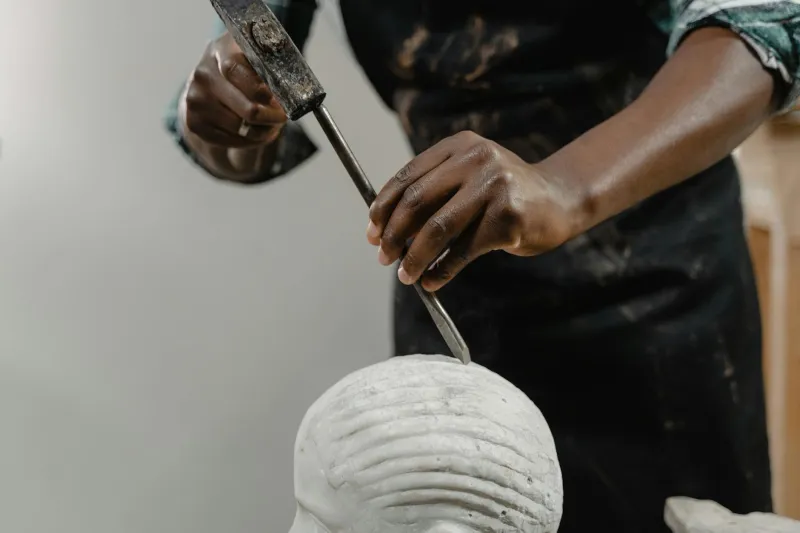
When Edmondson finally picked up his tools, he didn't head to an art supply store. He walked to his backyard in Nashville's African American community and started working with discarded limestone blocks—tombstone fragments and construction scraps that other people had thrown away.
He carved with railroad spikes, old chisels, and whatever sharp objects he could find. No formal training meant no preconceptions about what limestone could or couldn't do. While trained sculptors might have seen limitations, Edmondson saw possibilities.
His first pieces were tombstones for neighbors who couldn't afford store-bought markers. Simple, powerful, direct. The kind of work that said exactly what it meant without apology.
The Art World Discovers the Invisible Man
By the mid-1930s, word about the self-taught sculptor in Nashville had reached the ears of people who mattered in the art world. But when photographer Louise Dahl-Wolfe arrived to document Edmondson's work in 1937, she found something the establishment hadn't expected.
Here was an artist who carved angels with the confidence of someone who'd actually met them. His limestone figures—preachers, animals, biblical scenes—carried a spiritual weight that felt ancient and immediate at the same time. They weren't trying to impress anyone or follow any movement. They were simply true.
Breaking Every Rule by Not Knowing Them
What made Edmondson's work revolutionary was precisely what the art establishment usually rejected: complete ignorance of artistic convention. He'd never studied proportion or composition or any of the technical skills that art schools spent years teaching.
Instead, he carved the way he saw. His figures were sometimes anatomically impossible but emotionally perfect. His angels looked like they could actually fly, not because he understood aerodynamics, but because he understood faith.
"I just does it," he explained to reporters who asked about his technique. "The Lord just tells me what to cut and how to cut it."
Making History Without Trying
In 1937, the Museum of Modern Art in New York gave Edmondson something no Black artist had ever received: a solo exhibition. The show, titled "Sculptures by William Edmondson," featured twelve of his limestone pieces.
 Photo: Museum of Modern Art, via media.rightmove.co.uk
The art critics didn't know what to make of him. Here was work that felt both primitive and sophisticated, religious and universal, local and timeless. It didn't fit into any of the categories they used to organize the art world.
But visitors understood immediately. They stood in front of Edmondson's carved angels and preachers and felt something that gallery-goers rarely experienced: the presence of an artist who was saying exactly what he meant.
The Power of Not Belonging
Edmondson's greatest artistic asset was his complete outsider status. He'd never been to an art opening or read an art magazine or worried about what critics might think. He carved because he felt called to carve, and he carved what felt true to him.
This freedom from artistic politics and trends gave his work a directness that trained artists often spent years trying to unlearn. While they were figuring out how to be original, Edmondson was simply being himself.
His limestone figures felt like they'd been waiting inside the stone for someone honest enough to find them.
Legacy of the Unlikely
William Edmondson died in 1951, but his influence on American art continues to ripple outward. His work now sits in the collections of major museums across the country, and his approach—trusting intuition over instruction, authenticity over technique—has inspired generations of artists.
More importantly, his story proves something that the art establishment has always resisted: that the most powerful art often comes from the most unlikely places. Sometimes the best preparation for creating something extraordinary isn't learning what everyone else knows—it's maintaining the courage to see what everyone else has missed.
Edmondson spent his first fifty-seven years invisible to the art world. It turned out that invisibility was exactly the perspective he needed to create something no one could ignore.