The Man Who Mopped the Floors and Solved the Problem: A Janitor's Journey Into Biochemistry

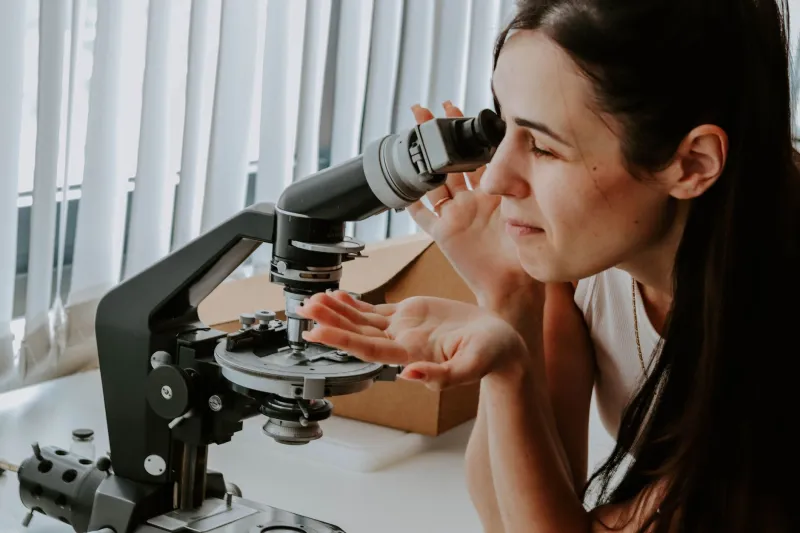
Photo: janitor cleaning laboratory hallway at night research facility, via kwestmortgage.com
There's a version of the American success story that starts in a garage, or a dorm room, or maybe a cramped apartment with a laptop and a dream. This isn't that story.
This one starts with a mop bucket.
For years, James Rhinehart worked the overnight custodial shift at a federally funded research institute in the Midwest — the kind of place where PhDs outnumbered parking spaces and the hallways smelled like antiseptic and ambition. He wasn't supposed to learn anything there. He was supposed to keep the floors clean.
He did that. And then he did something else entirely.
What Nobody Else Saw at 2 a.m.
There's a particular kind of silence that settles over a research building after midnight. The centrifuges spin. The refrigerators hum. The whiteboards still hold the ghost of whatever argument broke out before everyone went home.
Rhinehart, who had dropped out of high school in rural Kentucky at sixteen and spent his early twenties drifting between construction sites and warehouse gigs, found himself standing in front of those whiteboards every single night. At first, he says, it was just curiosity — the same instinct that made him good at fixing engines and reading weather patterns without a forecast.
But the equations didn't stay foreign for long.
He started asking questions during the brief windows when researchers were still around — not the kind of pestering that gets you fired, but careful, well-timed questions that made a few of the younger postdocs stop and actually think. He borrowed discarded textbooks from the recycling bins. He spent his lunch breaks reading journal abstracts in the break room, slowly learning the vocabulary of a world he'd never been formally invited into.
Nobody assigned him any of this. Nobody rewarded him for it. He just kept showing up.
The Advantage of the Invisible
Here's something the credentialed world rarely admits: proximity matters as much as pedigree. Sometimes more.
Researchers who spend years inside a single theoretical framework can develop a kind of tunnel vision — not because they aren't brilliant, but because brilliance, left uninterrupted, tends to run in grooves. Rhinehart didn't have grooves. He had wide-open, untrained eyes and a job that required him to move through every corner of the building every single night.
He noticed patterns that the day shift missed — not because he was smarter than the scientists, but because he was watching from a different angle entirely. He noticed which experiments got abandoned. He noticed which results seemed to confuse the researchers who ran them. He noticed, one particular winter, that a recurring anomaly in a protein-folding study kept getting set aside rather than explained.
It nagged at him the way a loose bolt nags at a mechanic.
So he did what any sensible person with no formal authority would do: he wrote it down, worked through it as best he could with the knowledge he'd pieced together over years of informal study, and eventually — with considerable nervousness — handed a handwritten note to the lab's lead researcher.
When the Lab Took Notice
The researcher, by most accounts, was initially skeptical. Politely so, but skeptical. A custodian handing over scientific observations wasn't exactly part of the standard research pipeline.
But the note was specific. It referenced the correct terminology. It pointed to a variable the team had, in fact, been quietly puzzled by. And the hypothesis it proposed — rough and unpolished as it was — wasn't wrong.
What followed wasn't a Hollywood montage. It was slow, institutional, and occasionally frustrating. Rhinehart was invited to sit in on a few lab discussions. He was given access to some entry-level materials. A younger researcher took him under her wing informally, helping him formalize what he'd taught himself into something communicable within the scientific community's standards.
Eventually, his name appeared in the acknowledgments of a published paper. Then, after he'd enrolled in community college and completed a formal chemistry track, in the author list itself.
It took nine years from that first handwritten note to that byline. Nine years of mopping floors, attending night classes, and doing the slow, unglamorous work of earning a place at a table nobody had saved for him.
What Fancy Credentials Sometimes Can't Buy
Rhinehart's story matters for reasons that go beyond the inspirational headline. It points to something real about how knowledge actually forms — and how institutional gatekeeping sometimes keeps the wrong people out.
Blue-collar workers in elite environments occupy a strange position. They're present for everything and credited for nothing. They hear the arguments, watch the failures, observe the habits of some of the most educated people in the country. And because nobody's performing for them, they see the unfiltered version of how discovery actually works — which is mostly people being wrong, confused, and stubborn in rotating combinations.
That kind of observation builds a different kind of intelligence. Not better than formal training, but not lesser, either. Complementary. The kind that notices the thing everyone else has learned to stop noticing.
Rhinehart himself puts it plainly: "When you clean a room, you see everything in it. Scientists see what they're looking for. I was looking at all of it."
The Quiet Lesson
He still teaches now — community college, introductory biochemistry, night sessions mostly. His students skew older. Career changers. People who took the long way around. He tells them, without sentimentality, that the credential is a door and not a destination.
The real work, he says, is learning to see.
And that, it turns out, has never required a particular starting point. Just a willingness to keep showing up — mop or no mop — and pay attention to what everyone else walked past.