Chalk Dust and Quiet Thunder: Five Teachers Who Accidentally Changed American History
The Classroom Nobody Wanted
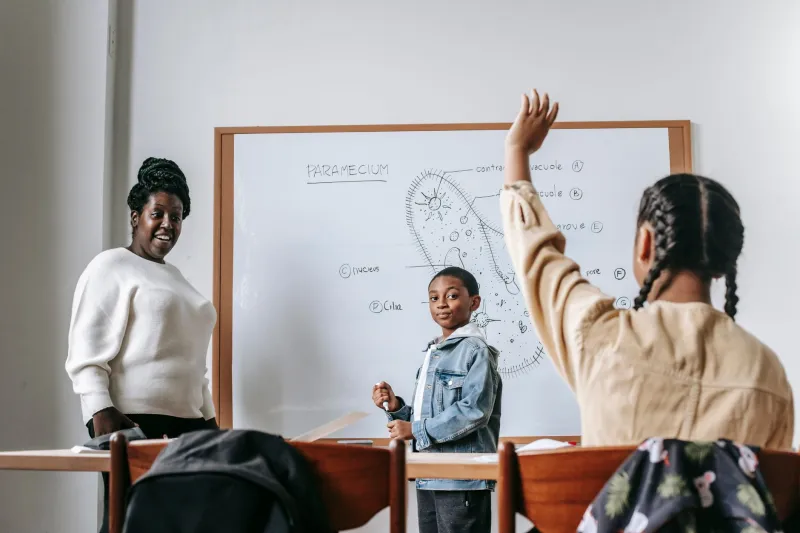
There is a recurring pattern in American history that is easy to miss because it doesn't announce itself. The powerful moments — the speeches, the rulings, the breakthroughs — get the attention. What gets overlooked is the room where it all began. The small, underfunded, easy-to-dismiss room where someone stood in front of a handful of young people and decided, against all practical logic, that what happened in that room mattered enormously.
Sometimes they were right in ways they never lived to see.
These are five of those rooms — and the people who stood in them.
1. Susie King Taylor — The Barn Classroom, 1862
She was twenty years old when she started teaching, which was already illegal. She was Black, in Georgia, and she had learned to read by hiding her lessons from the people who owned her — borrowing books, studying in secret, paying for knowledge with the constant low-level terror of discovery.
When the Civil War came and she found herself free for the first time, she didn't wait for anyone to tell her what to do with that freedom. She set up a school in a barn on St. Simons Island, South Carolina, for formerly enslaved children and adults who had never been allowed to hold a book in their own hands.
The school had no desks, no proper supplies, and no official sanction. What it had was Susie King Taylor, who understood with bone-deep certainty that literacy was not a luxury. It was the mechanism of everything else. You could not vote, could not sign a contract, could not protect yourself legally, could not fully participate in the freedom that was supposedly now yours, if you could not read.
She taught for free. She never made a dollar from it. She later served as a nurse and laundress for the 33rd United States Colored Troops, and she eventually wrote one of the first memoirs by a Black woman about the Civil War — a document that historians now consider indispensable.
But the barn came first. The barn, and the children inside it learning to read in the middle of a war, and a twenty-year-old woman who had decided that the most revolutionary act available to her was to share what she knew.
2. Emma Willard — The Parlor School, 1814
The year was 1814. Emma Willard had applied to the University of Vermont for permission to audit courses — not to enroll, just to sit in the back and listen — and had been turned down. Women were not admitted. Women were not considered capable of serious academic study. This was not a fringe position; it was the institutional consensus.
Willard's response was to open her own school in her home in Middlebury, Vermont, and teach the subjects that universities refused to teach women: mathematics, philosophy, the classical curriculum that prepared men for public life. She called it the Middlebury Female Seminary. She had no endowment, no board, and no official recognition.
What she had was a plan — a detailed, systematic argument for why women deserved rigorous education — and the audacity to present it to the New York state legislature in 1819. The address she delivered, 'A Plan for Improving Female Education,' was one of the first formal arguments for women's education ever made to an American legislative body.
The legislature didn't give her the funding she asked for. But the governor of New York read the plan and helped her establish the Troy Female Seminary in 1821, which became the most rigorous institution of women's education in the country. Hundreds of her graduates went on to become teachers themselves, spreading a model of serious women's education across the American frontier.
She started in a parlor. She changed what an entire gender was allowed to learn.
3. Annie Sullivan — The Water Pump, 1887
Annie Sullivan herself had been nearly blind, raised in a poorhouse after her mother died and her father abandoned her, educated at the Perkins School for the Blind in Boston through a combination of stubbornness and institutional charity. She was not a trained teacher. She was twenty years old when she arrived at the Keller family home in Tuscumbia, Alabama, to work with a seven-year-old child who was deaf, blind, and had developed no language whatsoever.
The methods available to her were inadequate. The understanding of how to reach a child in Helen Keller's situation was essentially nonexistent. Sullivan improvised — tracing letters into Keller's palm, connecting the symbols to objects, working with a patience and creativity that had no manual to draw from.
The moment at the water pump — when Helen Keller understood for the first time that the letters being traced in her hand were a name for the cool water flowing over her fingers — is one of the most famous scenes in American educational history. What it represents is a teacher refusing to accept the limits of what was thought possible for a student the world had largely written off.
Keller went on to graduate from Radcliffe College, write fourteen books, and become one of the most influential advocates for disability rights and social justice in American history. She said, consistently and without qualification, that none of it would have happened without Annie Sullivan.
Sullivan never sought the spotlight. She spent her life in Keller's shadow, which was exactly where she wanted to be. Her outsider status — poor, partially blind, self-invented — had given her a relationship to impossibility that more comfortable people couldn't access. She didn't know it couldn't be done. So she did it.
4. Mary McLeod Bethune — The Five-Dollar School, 1904
She started with five dollars, four students, and a condemned building in Daytona Beach, Florida. She made ink from elderberries. She used charred wood for pencils. She baked sweet potato pies and sold them to construction workers to raise money for supplies.
Mary McLeod Bethune had been born in 1875 in Mayesville, South Carolina, the fifteenth of seventeen children of formerly enslaved parents. She had received an education through the extraordinary intervention of a missionary school and a scholarship that she was told, when she applied for a position teaching abroad, she could not use — because the mission board didn't send Black women overseas.
Instead of accepting that closed door, she opened her own. The Daytona Literary and Industrial School for Training Negro Girls became, eventually, Bethune-Cookman College. But before it was a college, it was a dirt-floor classroom in a condemned building, with a woman who believed with complete conviction that education was the most powerful force available to people the country had decided to keep powerless.
Bethune went on to advise four presidents. She founded the National Council of Negro Women. She became, in the 1930s, the first Black woman to head a federal agency, directing the Division of Negro Affairs under Franklin Roosevelt.
All of it grew from the five-dollar school. All of it grew from the decision, made in a condemned building with elderberry ink, that the children in front of her deserved everything.
5. Jonathan Clarkson Gibbs — The Reconstruction Classroom, 1868
He had graduated from Dartmouth and Princeton Theological Seminary, which made him almost uniquely educated for a Black man in 1860s America — and almost uniquely unemployable in the South that was slowly, violently reassembling itself after the Civil War.
Gibbs came to Florida during Reconstruction and threw himself into education with a systematic ferocity. He became Florida's Secretary of State and later Superintendent of Public Instruction, where he oversaw the creation of a public school system for Black Floridians that had not existed before — building schools, training teachers, fighting the systematic defunding that white legislators pursued at every turn.
He understood that what was happening in those classrooms was not just education. It was the construction of a citizenry. It was the building of the infrastructure of participation — the ability to vote knowingly, to argue legally, to exist in public life as a full person rather than a subject.
He died in 1874, possibly poisoned, before he could see what he had built fully take shape. Florida's Reconstruction-era public school system did not survive the political reversals of the following decades intact. But the teachers he trained, the schools he established, and the students who passed through them carried something forward that could not be entirely dismantled.
The classroom was the most durable revolution he had access to. He used it completely.
The Argument That Runs Through All of Them
None of these five people were close to power when they did their most important work. They didn't have the ear of the powerful, the resources of the powerful, or the protection of the powerful. What they had was proximity to young minds at a moment when those minds were still forming — when the question of what was possible was still genuinely open.
That proximity, it turns out, is not a consolation prize for people who couldn't get closer to the action. It is, in the long run, the action itself.
The speeches and the legislation and the landmark decisions are real, and they matter. But behind almost every one of them, if you trace the line back far enough, there is a room. A small, underfunded, easy-to-dismiss room. And someone standing at the front of it who decided, for reasons that probably looked impractical at the time, that what happened there mattered enormously.
They were right. They are always right. And history keeps forgetting to tell them so.