Midnight Tinkerer, Billion-Dollar Inventor: The Extraordinary Ordinary Life of Lonnie Johnson
Midnight Tinkerer, Billion-Dollar Inventor: The Extraordinary Ordinary Life of Lonnie Johnson
It was somewhere around midnight when the bathroom of a rented house in Marietta, Georgia, became the unlikely birthplace of a cultural icon. Lonnie Johnson wasn't trying to invent anything that night. He was testing a heat pump he'd built from scratch — a device that used water instead of freon, part of a side project he'd been nursing alongside a full-time career at NASA's Jet Propulsion Laboratory. He connected a nozzle to the bathroom faucet, aimed it at the tub, and pulled the lever.
The stream of water that shot across the room was powerful enough to stop him cold.
That, he thought, would make one heck of a water gun.
What followed that moment — the years of rejection, the near-misses, the patent battles, and eventually the staggering commercial triumph — is a story about what happens when a mind that was never supposed to get very far simply refuses to stop moving.
The Kid Who Built a Robot in High School
Lonnie George Johnson grew up in Mobile, Alabama, in the 1950s and '60s, the third of six children in a working-class family that had very little money and a great deal of resourcefulness. His father was a driver for the Air Force. His mother was a nursing assistant. Neither had the means to stock a workshop or fund experiments, but that didn't stop Lonnie from turning the family home into something resembling a low-budget research lab.
By the time he was a teenager, he was taking apart anything he could get his hands on — radios, appliances, toys — not to break them but to understand them. At thirteen, he built a go-kart powered by a lawnmower engine. At fifteen, he was mixing rocket fuel in the backyard, a hobby that earned him a visit from the local fire department and, presumably, a long conversation with his parents.
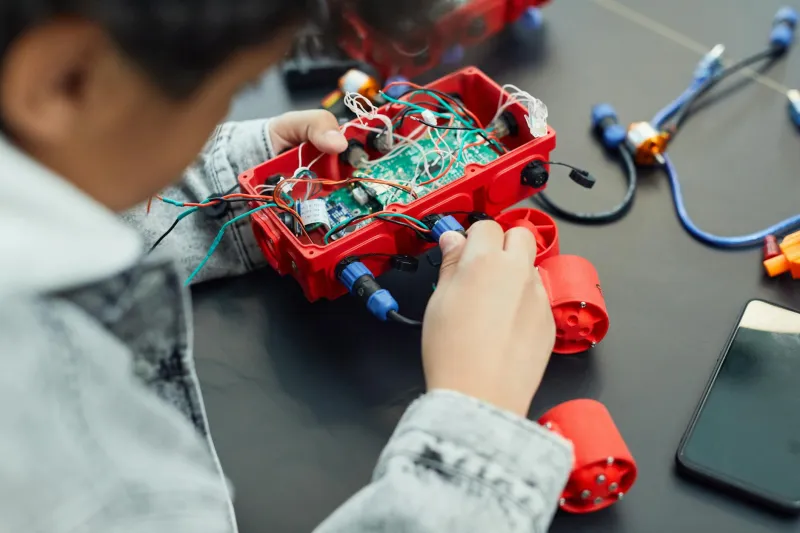
But it was his senior year project that announced something genuinely different. Johnson built a robot — a walking, remote-controlled machine he called Linex — out of scrap metal, reel-to-reel tape motors, and whatever else he could salvage. He entered it in a science fair at the University of Alabama, competing against students from schools with real resources. He won first place. He was the only Black student in the competition.
The achievement got him noticed. It also got him a full scholarship to Tuskegee University, where he studied mechanical engineering and became the first student to win the school's engineering award. From there, the trajectory looked almost conventional: Air Force officer, nuclear safety officer, then a position at NASA's Jet Propulsion Laboratory, where he worked on the Galileo mission to Jupiter and the Mars Observer spacecraft.
Conventional, except that Johnson never stopped tinkering at home.
The Invention Nobody Wanted
After that bathroom epiphany in 1982, Johnson spent the next several years developing his water gun concept. He built a prototype using a two-liter soda bottle and PVC pipe. He showed it to his daughter, who took it outside and soaked every kid on the block. The feedback was unambiguous.
But getting a toy company to share his enthusiasm was another matter entirely.
Johnson pitched his invention to the toy industry for years. He flew to trade shows. He set up demonstrations. He watched executives get visibly excited, then go quiet when the licensing talks got serious. Some were skeptical the market existed. Others had concerns about a toy that used water so aggressively. A few deals came achingly close before falling apart. One company strung him along for nearly a year before backing out.
He kept his day job at NASA. He kept refining the prototype. He kept filing patents — eventually accumulating 26 of them related to the water gun alone. And in 1989, he finally got a meeting with Larami Corporation, a small toy manufacturer in Philadelphia.
This time, the prototype shot water clear across the conference room and splattered the wall behind the executives.
They signed a deal within months.
A Billion-Dollar Accident
The Super Soaker launched in 1990. By 1991, it was the best-selling toy in America. By 1993, cumulative sales had crossed $200 million. The brand would eventually generate over a billion dollars in retail revenue, reshaping the water gun category so completely that the cheap, dribbling squirt guns of previous generations essentially ceased to exist.
Johnson, who had negotiated a royalty deal rather than a flat buyout, earned enough to fund his next obsession: a clean energy technology company called Johnson Research and Development, based in Atlanta. There, he's been working for decades on a solid-state battery technology and a thermoelectric energy conversion system called the Johnson Thermo-Electrochemical Converter — a device that, if it reaches its theoretical potential, could dramatically improve the efficiency of solar energy systems.
He holds more than 80 patents in total. He's won more engineering awards than most people have heard of. And he did all of it without ever quite fitting the profile of the person the system expected to do these things.
What the Story Is Actually About
It would be easy to frame Lonnie Johnson's life as a triumph-over-adversity narrative — the Black kid from Alabama who beat the odds, cracked the code, made it big. That frame isn't wrong, exactly, but it undersells something important.
Johnson didn't succeed by finding a way around the obstacles. He succeeded because he was constitutionally incapable of stopping. The years of rejection from toy companies weren't a test he endured — they were just the interval between one version of the prototype and the next. The midnight experiments weren't desperation; they were what the evenings were for.
There's a version of this story where the system wins — where the kid from Mobile never gets the scholarship, or the NASA job doesn't leave room for side projects, or the fifteenth toy company rejection is the one that finally sticks. That version is plausible. It's probably happened to people just as gifted.
But Johnson kept a notebook. He kept a workshop. He kept showing up to meetings with a prototype that shot water across the room.
Sometimes, that's the whole difference.